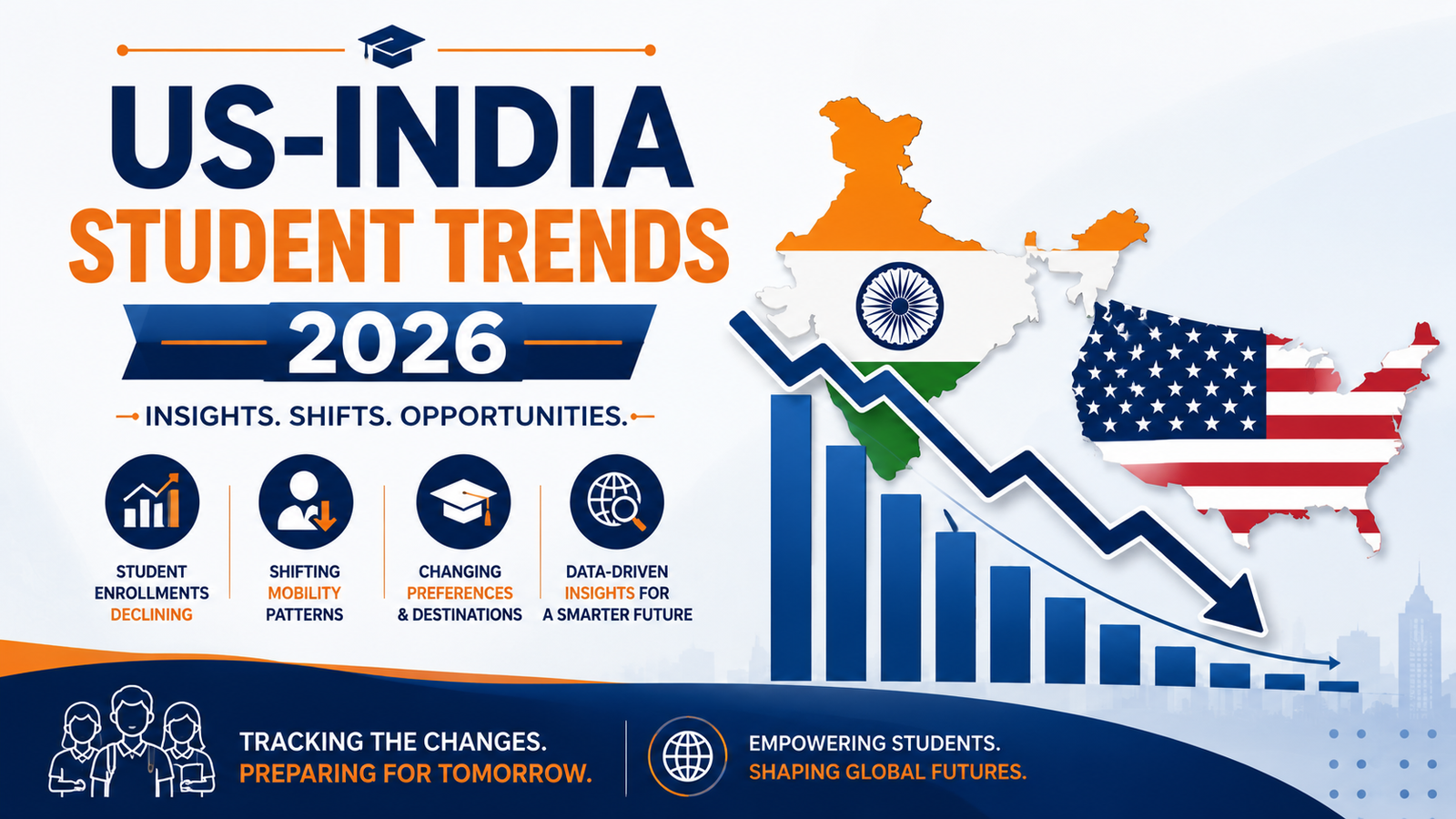
For years, India has been one of the most important source markets for US higher education — sending hundreds of thousands of students annually and powering entire academic departments, particularly in STEM fields. But new survey data suggests that pipeline is cooling significantly, and it’s becoming one of the biggest factors shaping a softer overall enrollment outlook for US universities in 2026/27.
Here’s what the latest data shows, why Indian demand is shifting, and what it could mean for US higher education going forward.
What the New Survey Found
The Institute of International Education (IIE) conducts a twice-yearly snapshot survey of US colleges and universities, and its latest 2026 Spring Snapshot on International Educational Exchange — gathered from 585 institutions between early May and mid-June 2026 — paints a fairly stark picture:
- 59% of responding institutions report a decrease in application volumes for 2026/27
- Only 14% report an increase, while 20% say volumes are roughly flat
- 63% of institutions expect a decline in international student enrollment for the coming academic year
- Just 11% forecast an increase, with 26% expecting stability
Among the 21 leading sending countries tracked in the survey, most showed stable or increasing application trends. India stood out as the clear exception — only 39% of responding institutions reported stable or increased applications from Indian students, making it the most pronounced decline among all major markets surveyed.
Why Is Indian Demand Softening?
Several overlapping factors appear to be driving the shift:
Rising visa rejection rates. Separate data has shown a marked increase in F-1 visa refusals for applicants from several key markets, including India, over the past year. As scrutiny increases and approval odds become less predictable, some prospective students may be reconsidering the US as their top choice.
Regulatory uncertainty. With major policy changes underway — including the shift away from “duration of status” and pending reforms to OPT and the H-1B work visa program — many Indian families are factoring in greater uncertainty about the full study-to-career pathway that has traditionally made the US so attractive.
Growing alternative destinations. As other countries expand their international education offerings and simplify visa pathways, students who might once have defaulted to the US are increasingly weighing options elsewhere.
Why This Matters So Much for US Higher Education
India’s importance to the US international education ecosystem is difficult to overstate. Indian students play an outsized role across multiple parts of the pipeline:
- They represent more than 70% of enrollments in master’s and PhD-level STEM programs at many US institutions
- Nearly half of all STEM-OPT participants are Indian nationals
- Roughly 75% of all H-1B work visas go to Indian nationals, largely in tech sector roles
- Indian-born professionals make up close to a quarter of Silicon Valley’s tech workforce with bachelor’s degrees or higher
- Indian-trained doctors represent the largest single group of immigrant physicians in the United States
Given this concentration, even a modest pullback in Indian student demand could have outsized effects — not just for individual universities’ enrollment numbers and revenue, but for entire STEM departments, research output, and the broader US tech and healthcare workforce pipeline.
Part of a Broader Global Pattern
This isn’t happening in isolation. Indian demand softening for the US comes at the same time that other traditional “Big Four” study destinations — Australia and the UK in particular — are also seeing declining international enrollment, driven largely by rising visa costs, stricter compliance requirements, and higher rejection rates in their own systems.
Meanwhile, institutions in Asia and Europe are reporting the opposite trend, with many seeing enrollment growth even as the traditional English-speaking “Big Four” destinations tighten their policies. This suggests a broader reshuffling of global student mobility patterns is underway — one where students, including many from India, may increasingly look beyond the traditional destinations that once dominated their study-abroad shortlists.
What This Means for Universities and Prospective Students
For US institutions, the message from industry analysts has been consistent: universities that stay agile, communicate proactively with prospective students, and adapt their recruitment strategy to the current policy environment are best positioned to weather these shifts.
For prospective Indian students specifically, this environment calls for more careful planning:
- Apply early and prepare thorough documentation to reduce visa refusal risk
- Research alternative destinations alongside US options, given the wider range of choices now available globally
- Factor in post-graduation pathway uncertainty, particularly around OPT and H-1B, when comparing study destinations
- Work closely with your institution’s international office to stay current on evolving visa and compliance requirements
Final Thoughts
The softening of Indian student demand for US universities in 2026/27 isn’t just a numbers story — it’s a signal of how interconnected visa policy, regulatory uncertainty, and global competition for talent have become. With India historically one of the most important pillars of US international education, this trend is one worth watching closely in the months ahead.
Stay connected with Savvy Bazar for continued coverage of international education trends, visa policy shifts, and study-abroad insights.